For more information or advice, relating to training and tuition or to arrange a trial flight, please contact the club training co-ordinator (details below):
Colin Barker – DDMAC Training Co-ordinator
Mobile: 07877 563 634
Email: Col.barker50@gmail.com
The club try to hold a regular tuition and advice session, on a Tuesday afternoon from 12.00pm to 4.00pm at the DDMAC flying field. These sessions are subject to the weather conditions & availability of an instructor on the day.
The club utilise a secure members ‘WhatsApp’ group for members to use to see who is going to the field and whether any training sessions are going ahead or not.
With some prior notice, training can usually be arranged on most days of the week, subject to instructor availability.
Which Mode?
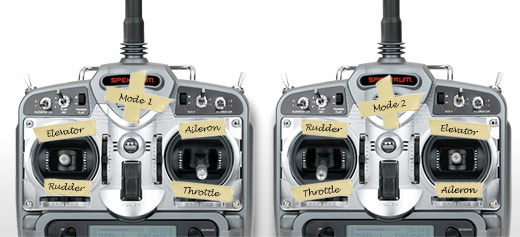
One of the most important things you must decide when you first start to fly, is which mode to fly on. The mode relates to what the sticks on the transmitter do i.e. which control surface they operate.
There are 4 different modes. Mode 1 and Mode 2 are the most common, with modes 3 and 4 rarely used.Modern radio control equipment has advanced significantly in the last few years. In general, most radio sets have 4 channels or more. The transmitters have 2 sticks, which operate the 4 main functions that control the aircraft. These 4 functions are generally the throttle, aileron, rudder and elevator.
The position and layout of the functions on the transmitter is referred to as the mode.
The 2 most common modes, in use today, are Mode 1 & Mode 2.
Most modern radio sets today come set up on Mode 2. They have to be converted to the other modes. This is usually quite a simple process and only takes a couple of minutes.
Mode 1 sets have the following stick layout:
Throttle and aileron on the right-
Rudder and elevator on the left-
Mode 2 sets have the following stick layout:
Throttle and rudder on the left-
Aileron and elevator on the right-
Flying Tuition
DDMAC has a number of members who are authorised by the committee to act as club instructors. These members are all competent flyers and offer their help and advice free of charge. A full list of the instructors can be found at the foot of this page.
The club has two fixed wing training aircraft, which can be made available to any new members or prospective new members who wish to have a try at flying before making any purchase of a plane or equipment. The aircraft are set up with two transmitters, utilising the buddy facility (this will be explained and demonstrated). We have the necessary leads to connect to most Spektrum, JR and Futaba radio systems, to utilise the buddy system for your own model.
The club tries to make use of the buddy box system wherever possible to teach new members to fly. The buddy box system allows two transmitters to be connected together (one master and one slave transmitter), allowing the instructor to take control of the model quickly when needed. The system will be fully explained and demonstrated to any new members wishing to utilise it (it’s a lot easier and safer than trying to snatch a transmitter from a learner who has got into difficulties).
Flying Solo
You must hold a BMFA ‘A’ Certificate for the discipline that you want to fly (fixed wing, helicopter or multi rotor) before you can fly solo, without the supervision of a club approved instructor or an authorised flying supervisor at the DDMAC airfield (full details in the club rules).
Members who hold a BMFA ‘A’ helicopter certificate will be allowed to fly multi rotor models solo, without taking the separate multi rotor test.
Safe flying is paramount and the aim is to get any new flyers to pass the BMFA ‘A’ Certificate for the discipline they fly, to enable them to fly on their own. The club has a number of BMFA qualified examiners, available to help, advise and encourage you to take and pass the BMFA ‘A’ and ‘B’ achievement certificates.
Typical Training Aircraft

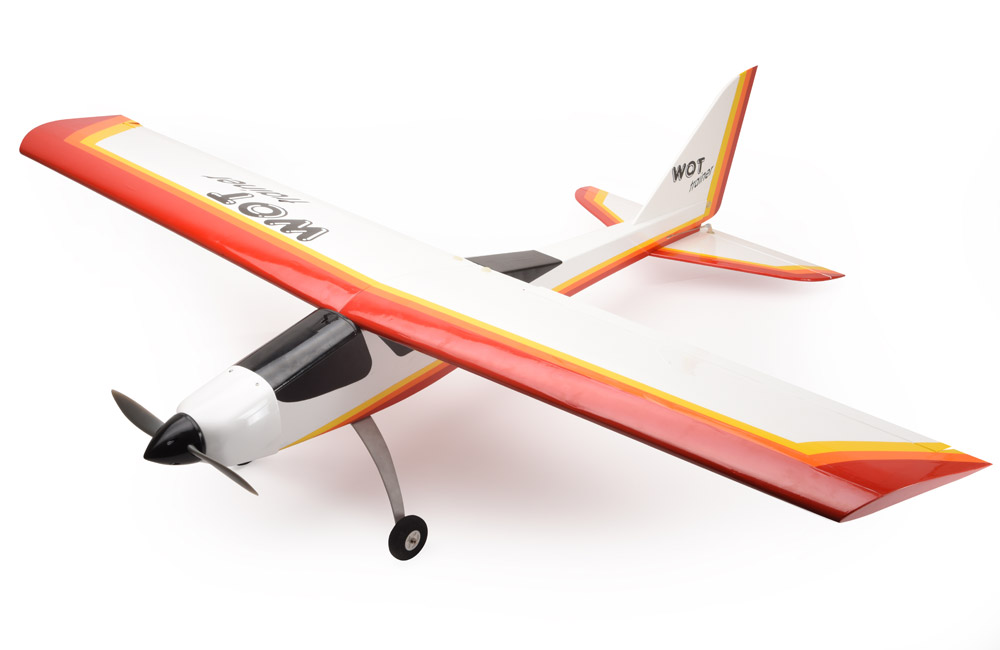
The above are typical training aircraft that are suitable to learn to fly with. Most trainers are high wing aircaft with some dihedral on the wing (angle at which the wings join at the centre). This makes them more stable and in general easier to control.
There are numerous trainers on the market today, from light foam ones, to the more traditional built up wooden structures.
DDMAC Club Instructors & BMFA Examiners
| Name | Fixed Wing Instructor | Helicopter Instructor | Mode 1 or 2 | BMFA Examiner |
|---|---|---|---|---|
| John Evans | Yes | No | 1 | Fixed Wing |
| Martin Lynn | Yes | Yes | 1 | Fixed Wing |
| Dave Wadsworth | Yes | Yes | 2 | No |
| Darren Nicholson | No | Yes | 2 | Helicopter |
| Colin Barker | Yes | No | 2 | No |
| Graham Worfolk | Yes | No | 2 | No |